

Why Your Pallet Wrapper Is Using Too Much Film (And How to Fix It)
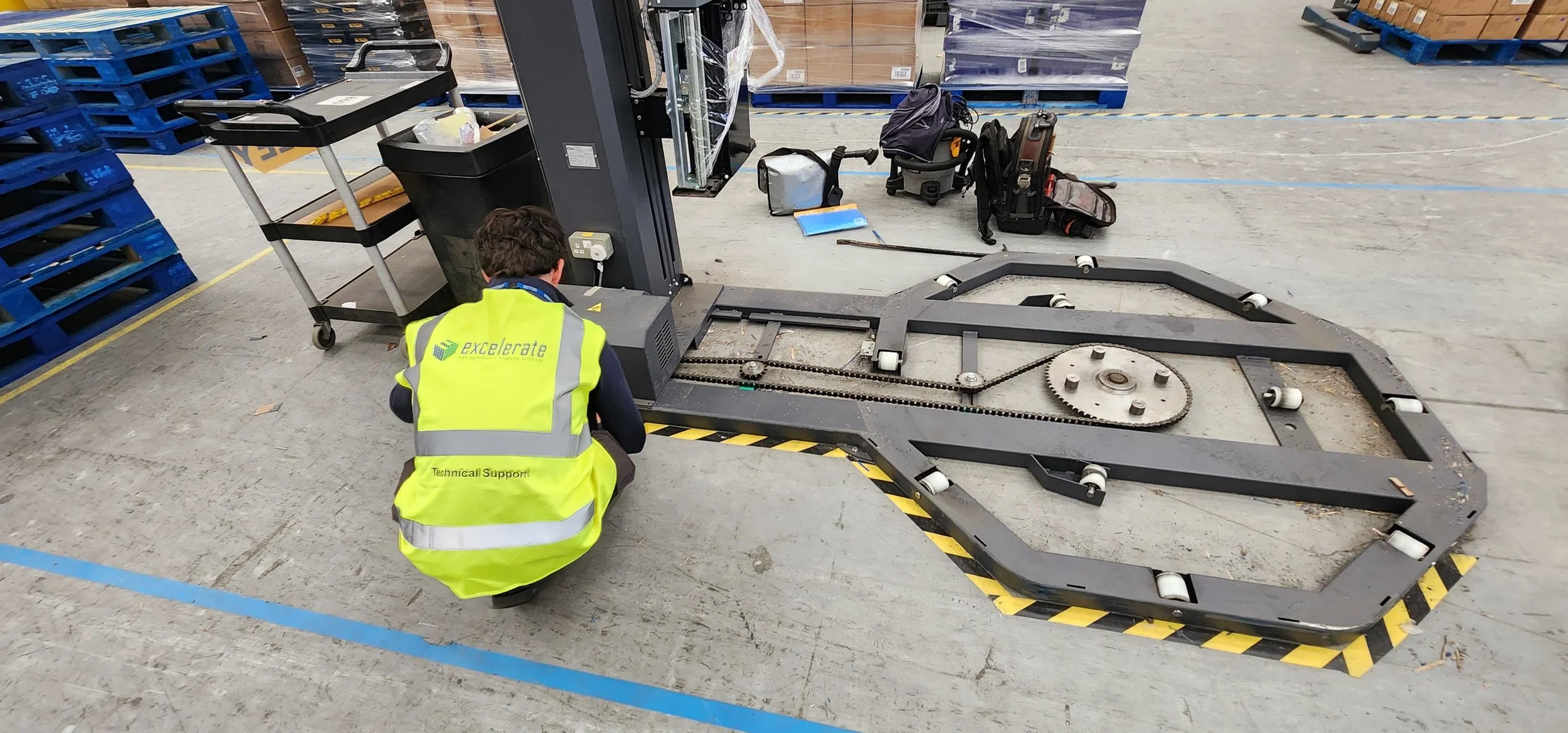
Scheduled pallet wrapping machine repair by an Excelerate in-house engineer
If your pallet wrapper is using too much film, it rarely shows up as a clear problem.
There is no alarm.
No obvious fault.
No complete breakdown.
Instead, you see:
film usage creeping up
more rolls being ordered
inconsistent wrapping
operators making small adjustments
Over time, the cost builds quietly into the system.
What’s Actually Happening
A pallet wrapper is designed to apply the minimum amount of film required to stabilise a load.
When it is set up correctly:
film is stretched efficiently
containment force is consistent
usage per pallet is controlled
When it is not:
more film is used than necessary
stretch levels are reduced
wrapping cycles become excessive
The machine still runs. But it becomes inefficient.
Common Causes of High Film Usage
We see the same patterns repeatedly across sites.
Incorrect machine setup
Pre-stretch and tension settings are not optimised, so more film is applied to compensate.
Low or inconsistent stretch levels
If the film is not being stretched properly, more material is used to achieve containment.
Excessive wrap cycles
Too many top or bottom wraps, or unnecessary revolutions.
Worn or underperforming components
Rollers, belts and carriage systems degrade over time, reducing efficiency.
Poor film selection
Using the wrong grade or specification of film for the load.
Operator intervention
Settings get changed over time to “tighten loads”, increasing usage without solving the root issue.
These issues are rarely obvious in isolation. They compound over time.
Why This Often Goes Unnoticed
Unlike a breakdown, high film usage does not stop production.
The machine continues to run.
So the issue is absorbed into:
purchasing
stock usage
daily operation
In many cases, no one is measuring:
film per pallet
actual stretch levels
cost per load
So the inefficiency is never challenged.
The Real Cost
This is where the impact becomes significant.
If a machine is using more film than it should:
cost per pallet increases across every load
annual film spend rises substantially
waste increases
margins are reduced without visibility
In some cases, sites are using 30–50% more film than necessary without realising.
Servicing vs Optimisation
This is where most operations fall short.
Servicing
keeps the machine running
replaces worn parts
prevents breakdown
Optimisation
reduces film usage
improves stretch performance
lowers cost per pallet
You need both.
Servicing alone does not guarantee efficiency.
What To Look For
If you suspect high film usage, look for:
increasing roll consumption without production increase
loads requiring multiple wraps to stabilise
inconsistent wrapping results
operators regularly adjusting settings
no clear benchmark for film usage per pallet
These are signs the system is not under control.
What To Do
The key is to assess the system properly.
Not just:
the film
the machine
or the settings
But how they all work together.
Small changes in:
pre-stretch
tension
wrap cycles
can significantly reduce usage without compromising stability.
If your pallet wrapper is using more film than expected, the issue is usually setup or machine performance rather than the material itself.
👉 View our pallet wrapping machine servicing and optimisation support:
https://www.excelerateltd.com/machinery-servicing
If usage has increased alongside faults or inconsistent performance, there may be an underlying mechanical issue.
👉 View our pallet wrapper repair page:
https://www.excelerateltd.com/pallet-wrapper-repair
Once the machine is set up correctly, film choice becomes the next driver of efficiency.
With the right specification and stretch performance, material usage can often be reduced significantly without compromising load stability. In many cases, sites are able to cut film usage by 30–70% once both the machine setup and material are aligned properly.
👉 View our high-performance pallet wrap solutions:
https://www.excelerateltd.com/pallet-wrap
High film usage is rarely a single issue.
It is the result of small inefficiencies across the system.
Until those are identified and corrected, the cost remains hidden in daily operation.
