

Rotary Arm Pallet Wrapper vs Turntable Wrapper: Which Is Right For Your Operation?
When comparing a rotary arm pallet wrapper with a turntable pallet wrapper, the question is not which machine is better.
The real question is:
Should the pallet rotate during wrapping, or should it stay still?
That single decision often determines which pallet wrapping machine is the correct fit for the operation.
Both systems apply stretch film around a pallet load. Both can improve load stability, reduce film waste and automate wrapping. However, they solve different operational problems and perform best in different environments.
What Is A Turntable Pallet Wrapper?
A turntable pallet wrapper rotates the pallet while the film carriage moves up and down the mast applying stretch film.
This is the most common type of pallet wrapping machine found in warehouses, manufacturing facilities and distribution centres.
Turntable pallet wrappers are often chosen because they are simple to operate, cost-effective and suitable for a wide range of pallet types. They are commonly available in semi-automatic and automatic configurations.
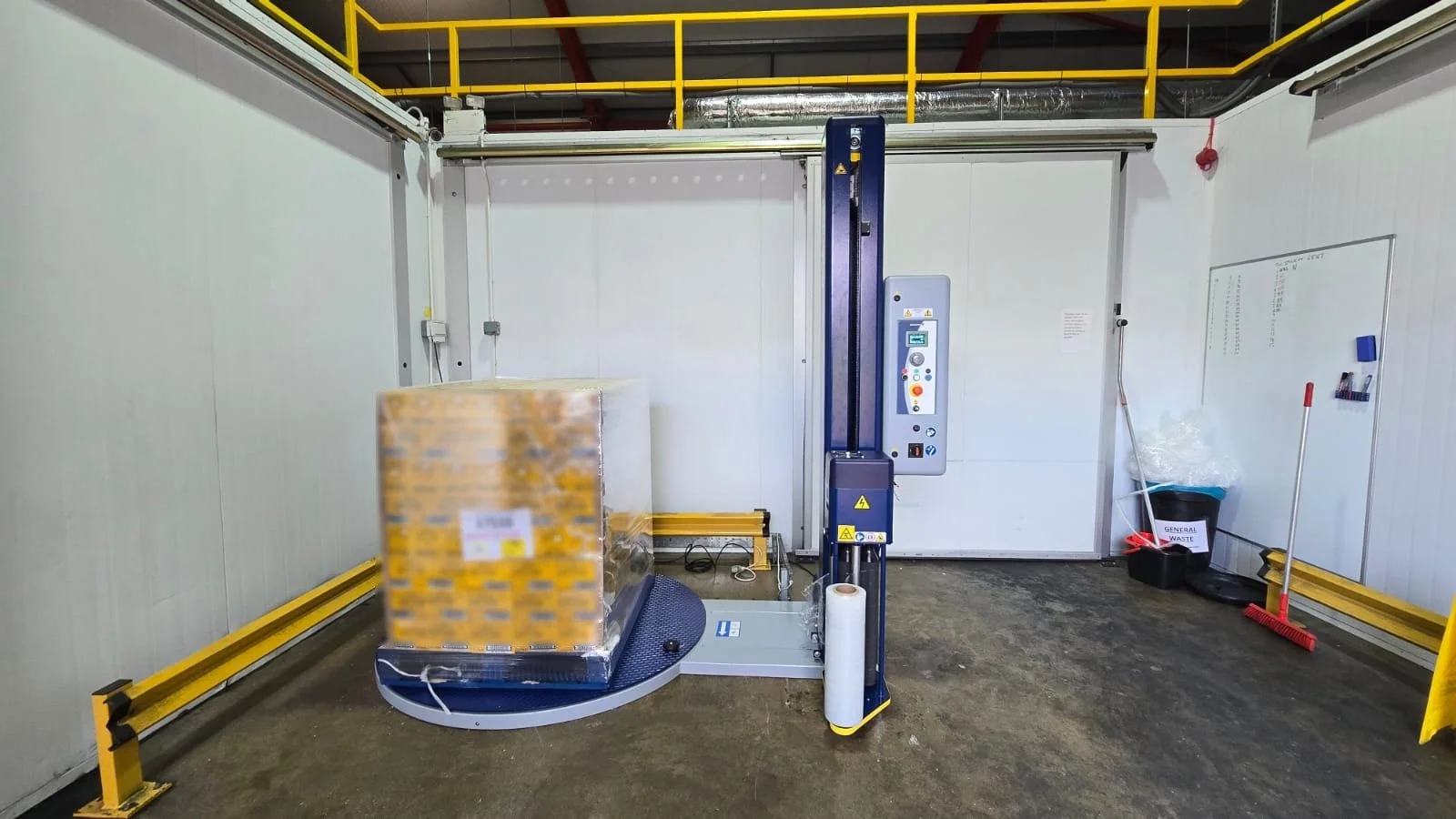
A turntable pallet wrapping machine
(also known as a pallet wrapper or stretch wrapper)
Typical Advantages
Lower capital investment
Compact machine footprint
Suitable for most standard pallet loads
Available with advanced powered pre-stretch systems
Strong return on investment for low and medium volume operations
Typical Limitations
The pallet must rotate during wrapping
Very unstable loads may shift during rotation
Extremely heavy loads can place additional strain on the system
Irregular pallet profiles can become problematic at higher turntable speeds
What Is A Rotary Arm Pallet Wrapper?
A rotary arm pallet wrapper keeps the pallet stationary while a rotating arm travels around the load applying stretch film.
Instead of rotating the pallet, the machine rotates the wrapping arm.
This design is particularly useful where load movement could create instability, damage or safety concerns. Rotary arm machines are commonly used for heavy, fragile, unstable or irregular pallet loads.
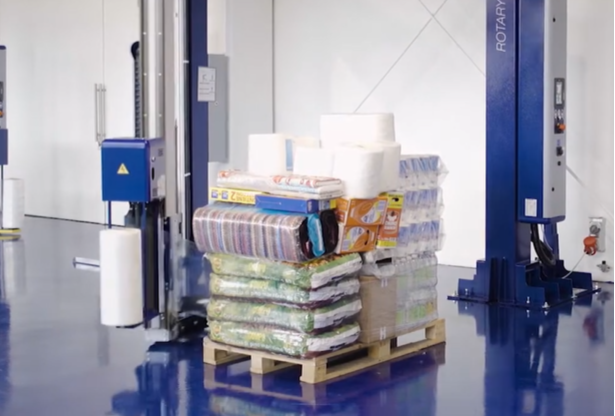
A rotary pallet wrapping machine
(also known as an arm wrapper, rotary wrapping machine)
Typical Advantages
Pallet remains completely stationary
Ideal for unstable loads
Suitable for very heavy pallets
Better suited to fragile products
Easier integration into automatic conveyor systems
Consistent wrapping performance at higher speeds
Typical Limitations
Higher initial investment
Larger installation footprint
Usually fixed in one location
Greater installation requirements
Rotary Arm vs Turntable Wrapper Comparison
| Feature | Turntable Wrapper | Rotary Arm Wrapper |
|---|---|---|
| Pallet Rotates | Yes | No |
| Load Remains Stationary | No | Yes |
| Capital Cost | Lower | Higher |
| Standard Pallet Loads | Excellent | Excellent |
| Fragile Loads | Good | Excellent |
| Unstable Loads | Limited | Excellent |
| Very Heavy Pallets | Good | Excellent |
| Conveyor Integration | Possible | Excellent |
| Available Space Required | Compact | Larger Footprint |
| High-Speed Automation | Good | Excellent |
When A Turntable Wrapper Is Usually The Better Choice
A turntable pallet wrapper is normally the correct choice when:
Pallets are stable
Products are boxed or shrink-packed
Daily pallet volume is moderate
Floor space is limited
Budget is a key consideration
Operators use pallet trucks or forklifts to bring loads to a dedicated wrapping station
For many businesses, a turntable pallet wrapper provides the best balance between cost, performance and operational simplicity.
When A Rotary Arm Wrapper Is Usually The Better Choice
A rotary arm pallet wrapper is often the better option when:
Loads are unstable
Products are fragile
Pallets are extremely heavy
Products overhang the pallet
High wrapping speeds are required
Full end-of-line automation is planned
Because the load remains stationary throughout the wrapping cycle, the risk of load movement is significantly reduced. This is often the deciding factor in food manufacturing, industrial products, paper reels, beverage production and other applications where load stability is critical.
The Most Common Mistake
One of the biggest mistakes businesses make is selecting a machine based solely on purchase price.
The cheapest pallet wrapper is not always the lowest-cost wrapping solution.
Film usage, containment force, load damage, labour efficiency, throughput and servicing all influence the true cost per pallet wrapped.
A correctly specified powered pre-stretch turntable wrapper may outperform a poorly specified rotary arm machine.
Likewise, an unstable load that regularly collapses on a turntable may justify a rotary arm wrapper almost immediately.
The machine should be selected around the load and the operation, not simply around the equipment cost.
Which Pallet Wrapper Should You Choose?
If your pallets are generally stable and your objective is reliable, cost-effective pallet wrapping, a turntable pallet wrapper is often the strongest choice.
If your loads are unstable, fragile, oversized or extremely heavy, a rotary arm pallet wrapper will usually provide better load protection and wrapping consistency.
The correct answer depends on:
Pallet weight
Product stability
Throughput requirements
Available floor space
Automation objectives
Film performance requirements
Every pallet wrapping system should ultimately be designed around containment force, load stability and the real operational environment.
